
Introduction
As enterprises push multi-agent systems from research prototypes into live production environments, a foundational architectural decision emerges early and dominates every downstream engineering choice: should a single orchestrator control all agent interactions, or should coordination logic be distributed across autonomous agents? The answer shapes everything from latency profiles and failure recovery to operational complexity and long-term scalability. With North American tech companies accelerating enterprise agent orchestration deployments throughout 2026, many teams are making this decision without a rigorous framework for evaluating tradeoffs. The gap between choosing an architecture that works in a demo and one that survives production traffic at scale is where most multi-agent projects fail.
Understanding Orchestration Models for Multi-Agent Systems
Before evaluating which architecture fits a given workload, it is essential to understand what each model actually implies at the systems level. A multi-agent system consists of multiple autonomous or semi-autonomous agents collaborating to accomplish tasks that exceed the capability of any single agent. How these agents coordinate, share state, and recover from failures defines the orchestration model.
Centralized Orchestration: The Hub-and-Spoke Model
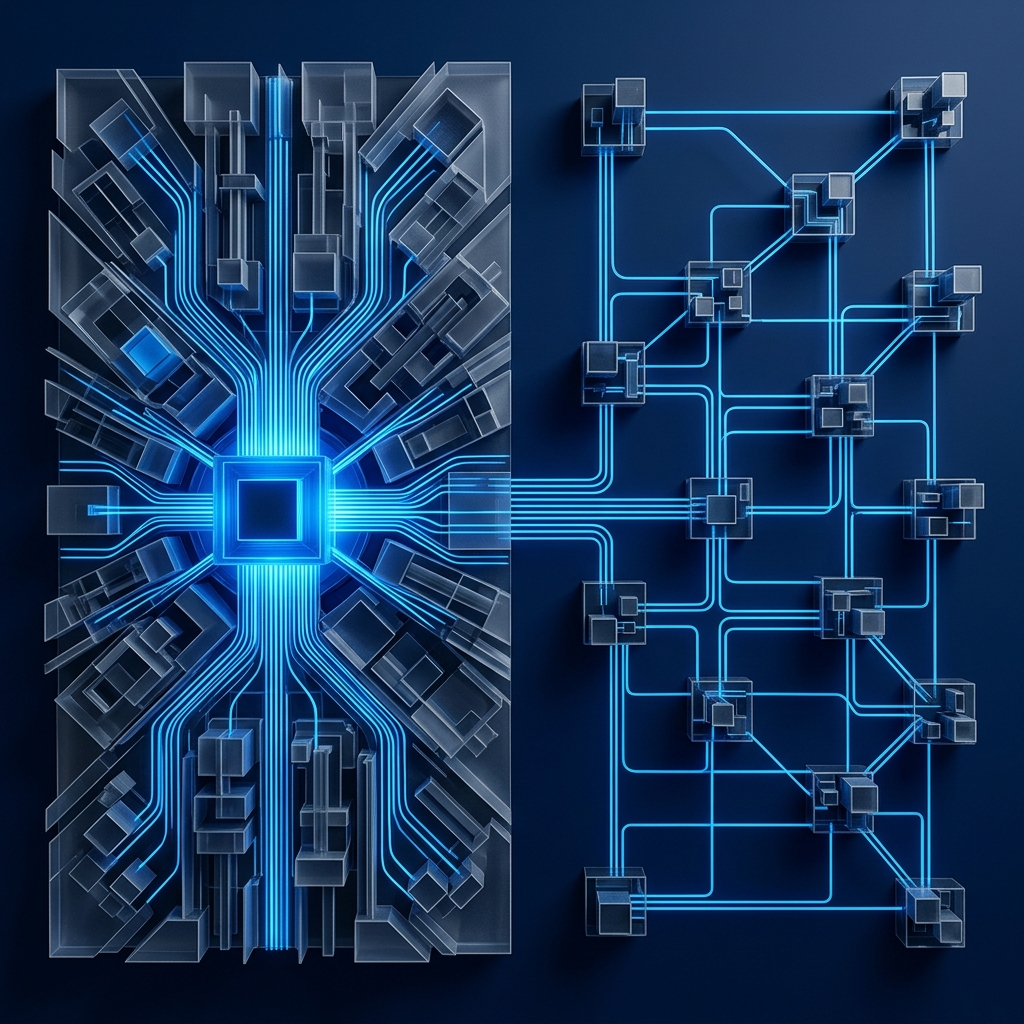
In a centralized architecture, a single orchestrator agent (or service) acts as the control plane. Every task assignment, data handoff, and error recovery decision flows through this hub. The orchestrator maintains a global view of system state, decides which agent handles which subtask, and sequences execution. Think of it as a conductor directing an orchestra: no musician plays without a cue from the podium.
Global state visibility: The orchestrator holds the canonical state of every in-flight workflow, making debugging and auditing straightforward.
Predictable execution order: Task sequencing is deterministic, which simplifies agent decision-making in workflows where order matters.
Simplified failure handling: When an agent fails, the orchestrator can retry, reroute, or gracefully degrade the workflow from a single decision point.
Lower inter-agent complexity: Agents do not need to know about each other; they only communicate with the orchestrator, reducing the number of communication paths.
Decentralized Choreography: The Peer-to-Peer Model
Decentralized choreography eliminates the central controller entirely. Each agent operates autonomously, reacting to events published by other agents. Coordination emerges from agreed-upon inter-agent communication protocols and shared event buses rather than top-down directives. This mirrors the choreography pattern familiar from microservice architecture, where services respond to domain events without a central coordinator. In production, this means agents subscribe to relevant event topics, process their piece of the workflow, and emit new events that trigger downstream agents.

Production Tradeoffs That Define the Architecture Decision
The choice between centralized and decentralized multi-agent orchestration patterns in production is not theoretical. It shows up in latency percentiles, on-call incident severity, and infrastructure cost. The following tradeoffs represent the dimensions that matter most when deploying autonomous agent architecture into real environments.
Scalability, Fault Tolerance, and Latency
Centralized orchestration introduces a natural bottleneck: the orchestrator itself. Every request passes through a single coordination layer. Under moderate load, this is manageable. At high throughput, the orchestrator becomes a scaling constraint that requires horizontal replication, session affinity, and careful load balancing. If the orchestrator goes down without proper redundancy, every active workflow halts simultaneously. This is the "blast radius" problem: a single point of failure with system-wide impact.
Decentralized systems distribute this risk. No single agent failure cascades across the entire system. Individual agents can scale independently based on their own workload characteristics. A document parsing agent might need 10 replicas while a summarization agent needs 3. However, the latency story is nuanced. In choreographed systems, a workflow that requires sequential processing across five agents accumulates latency at every event hop. Each hop involves message serialization, queue delivery, deserialization, and processing. In a centralized system, the orchestrator can optimize scaling strategies by parallelizing independent subtasks and batching sequential ones, often achieving lower end-to-end latency for complex workflows.
State Management and Observability Challenges
Agent state management in production is where architectural choices have their sharpest practical consequences. A centralized orchestrator naturally serves as the single source of truth for workflow state. Every agent reports back to the orchestrator, which maintains a complete execution history. This makes it relatively simple to implement the saga pattern for distributed transactions, where compensating actions roll back partial completions when a step fails.
In decentralized systems, the state is fragmented across agents. No single component knows the full picture. Reconstructing the current state of a workflow requires aggregating events from multiple agents, which introduces eventual consistency challenges. When an agent fails mid-workflow, determining what has already been completed (and what compensation is needed) requires querying event logs across the system. Multi-agent system monitoring becomes significantly harder because there is no central vantage point. Teams often end up building a dedicated observability layer that effectively recreates much of the state visibility a centralized orchestrator provides natively, adding infrastructure complexity without the coordination benefits.

Hybrid Approaches and Real-World Guidance
Production environments rarely conform neatly to either pure model. The most resilient multi-agent system designs adopt hybrid architectures that apply centralized control, which reduces risk, and decentralized autonomy, which it improves throughput. Understanding when to blend these patterns is where experienced engineering teams differentiate themselves.
When to Use Each Pattern (and When to Combine Them)
Centralized orchestration is the stronger default for workflows where correctness and ordering guarantees are non-negotiable. Financial transaction processing, regulatory compliance pipelines, and any workflow involving compensating actions benefit from a single coordinator that can enforce invariants. If agent failure handling and recovery needs to be deterministic and auditable, centralized control provides that guarantee with less engineering overhead.
Decentralized choreography fits workloads that are embarrassingly parallel, loosely coupled, and tolerant of eventual consistency. Content enrichment pipelines, large-scale data labeling, and monitoring systems where each agent operates on independent data partitions are natural candidates. US enterprises deploying multi-agent systems at scale have found success using choreography for high-throughput ingestion stages while centralizing control for the final aggregation and decision stages. NinjaStudio.ai has covered agent architecture patterns extensively, and the recurring finding is that hybrid designs outperform purist approaches in nearly every production scenario.
Production-Tested Implementation Guidance
Start with a centralized orchestrator and decompose outward only when scaling demands it. This is not a conservative instinct; it is a practical one. Centralized systems are easier to debug, easier to monitor, and easier to reason about when something goes wrong at 3 AM. Agent orchestration frameworks like LangGraph, CrewAI, and AutoGen provide centralized coordination out of the box, letting teams focus on agent logic rather than distributed systems plumbing. As specific agents prove to be throughput bottlenecks, extract them into independently scalable services that communicate through event buses while the orchestrator retains workflow-level control.
Invest heavily in observability from day one, regardless of architecture. Distributed tracing (OpenTelemetry), structured logging with correlation IDs, and workflow-level dashboards are non-negotiable for any production-ready multi-agent architecture. Teams that skip this step inevitably face the same crisis: a subtle agent misbehaviour that is invisible without cross-agent trace correlation. For teams evaluating inference cost tradeoffs alongside architectural decisions, the cost of retries and cascading failures in a poorly observed system often exceeds the infrastructure savings of any particular architecture choice. NinjaStudio.ai consistently emphasizes that the operational maturity of your monitoring stack matters more than the elegance of your agent topology.
Conclusion
The centralized versus decentralized orchestration decision is not a philosophical debate; it is an engineering tradeoff with measurable consequences for latency, reliability, and operational cost. Centralized orchestration provides simpler state management, deterministic failure recovery, and faster time-to-production, while decentralized choreography offers superior independent scalability and fault isolation for loosely coupled workloads. Most production systems benefit from a hybrid approach: centralize coordination for workflows that demand correctness guarantees, and distribute autonomy where throughput and isolation matter more. Start centralized, measure bottlenecks, and decompose deliberately.
Explore production-focused deep dives on agent architecture and AI systems engineering at NinjaStudio.ai.
Frequently Asked Questions (FAQs)
What is the difference between orchestration and choreography in agents?
Orchestration uses a central controller to direct agent interactions and sequence tasks, while choreography relies on agents independently reacting to events published by other agents without any central coordinator.
How do you handle failures in multi-agent systems?
Centralized systems use the orchestrator to detect failures and trigger retries or compensating actions (the saga pattern), while decentralized systems rely on dead-letter queues, idempotent event handlers, and agent-level health checks to isolate and recover from failures.
How do you manage agent state across multiple agents?
In centralized architectures, the orchestrator maintains canonical workflow state, while decentralized systems require event sourcing or a shared state store with conflict resolution to reconstruct consistent state across independently operating agents.
How do multi-agent systems communicate?
Agents communicate through direct API calls routed by an orchestrator in centralized systems, or through asynchronous message brokers and event buses (such as Kafka or RabbitMQ) in decentralized choreography patterns.
How do you monitor multi-agent systems in production?
Production monitoring requires distributed tracing with correlation IDs across all agents, structured logging aggregated into a central observability platform, and workflow-level dashboards that track end-to-end latency, error rates, and agent-specific health metrics.