Quick Answer
Hybrid AI infrastructure is winning because it places steady, predictable workloads on owned or reserved capacity while keeping cloud elasticity for model experimentation, large language models, and demand spikes. For most enterprises, the practical decision is not build or buy, but which workloads deserve control and which should remain flexible.
Introduction
Enterprise AI infrastructure should be designed around workload behavior, not a blanket preference for cloud or on-premises systems. Self-hosting can improve control for stable utilization, while managed services reduce the operational burden of fast-moving model development. The expensive mistake is treating every inference request, training job, and data boundary as if it has identical latency, governance, and capacity needs. A hybrid design turns those differences into placement rules instead of recurring architecture debates.
Key Takeaways:
Owned capacity works best for consistently utilized workloads with stable demand.
Cloud capacity preserves flexibility for experimentation and unpredictable AI demand.
Hybrid architectures require workload-level cost, governance, and latency decisions.
AI infrastructure decisions start with workload economics
The build-versus-buy question becomes clearer when teams separate fixed demand from variable demand. Production AI infrastructure is not simply a GPU purchase or cloud contract: it is the full operating model for data movement, model serving, observability, security review, and incident response.
When building compute earns its operating cost
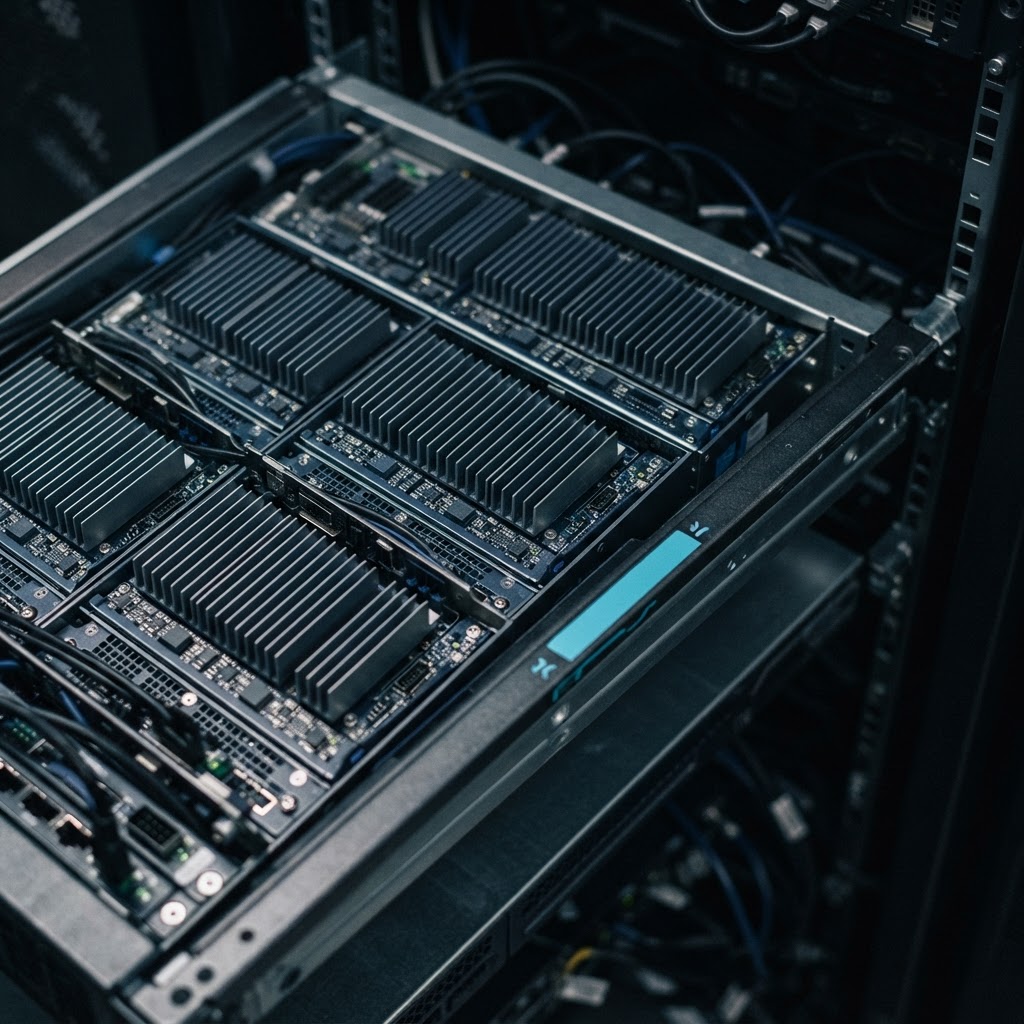
Building makes sense when utilization is sustained, data locality matters, and engineering teams can operate the stack as a long-term product rather than a temporary project. GPU clusters for AI also need power planning, cooling, networking, capacity forecasting, spare-part procedures, and disciplined scheduling before their theoretical cost advantage becomes real.
Stable inference: Repeated traffic makes capacity planning more dependable.
Data residency: Sensitive datasets may require tighter deployment boundaries.
Latency targets: Nearby compute reduces network-dependent response variance.
Platform ownership: Internal teams can standardize deployment and monitoring practices.
Why GPU cluster economics exceed hardware acquisition
Capital expenditure is only one line item. Energy availability, facility constraints, networking, staff coverage, model upgrades, and underused capacity determine whether self-hosting produces cost-effective AI infrastructure. Electricity demand has already become a planning constraint: data center electricity demand research from the Department of Energy shows the Electric Power Research Institute estimates data centers could consume up to 9% of U.S. electricity generation annually by 2030, up from 4% of total load in 2023. Teams evaluating GPU clusters should therefore validate local power availability and facility readiness alongside hardware economics.

Managed versus self-hosted AI infrastructure is not a binary choice
Managed versus self-hosted AI infrastructure compares operational models more than it compares raw hardware. A managed environment shifts provisioning and service operations to a provider, while self-hosting concentrates responsibility for capacity and reliability inside the enterprise. The same tradeoff appears at the team level, where the choice between The Ninja Studio's AI development services and an internal build decides who carries that responsibility day to day.
Compare build, buy, and hybrid by operational responsibility
Use this matrix to assign workloads based on what must be predictable, controlled, or elastic. Specific infrastructure pricing is customized or undisclosed in the available evidence, so the decision should be modeled on utilization, personnel, data-transfer, and reliability requirements rather than assumed rate cards.
Approach | Cost pattern | Control | Talent requirement | Scalability behavior |
|---|---|---|---|---|
Build | Upfront capacity commitment | Direct control of stack | High operational depth | Expansion requires planning |
Buy | Usage-linked spend | Provider-defined constraints | Lower infrastructure operations | Elastic within provider limits |
Hybrid | Fixed base plus variable overflow | Control for selected workloads | Shared platform discipline | Stable base with burst capacity |
Hybrid is most defensible when the organization can identify a reliable baseline workload and route exceptions elsewhere. That routing layer is the difference between a deliberate architecture and an accidental mix of tools.
Cloud infrastructure for large language models is particularly useful when model selection changes quickly, context sizes vary, or product launches create short-lived demand peaks. Retaining cloud capacity for these uncertain workloads avoids committing internal systems to models that may be replaced before their operating assumptions stabilize.
Control means governance, not merely access
Infrastructure control includes approval paths for model artifacts, dependency provenance, access permissions, auditability, and rollback procedures. This is why hybrid model deployment needs shared policies across every environment, not separate security standards for cloud and owned compute.
A useful operating pattern is to keep governed data preparation and repeatable inference near controlled systems, then use approved cloud accounts for temporary training, evaluation, and overflow. A hybrid model deployment strategy works only when identity, telemetry, model registries, and release rules follow the workload across boundaries.
Build a hybrid roadmap from evidence, not ideology
Start by classifying every workload according to utilization shape, sensitivity, latency tolerance, failure impact, and model volatility. An infrastructure roadmap should assign an owner to each placement decision and revisit it when traffic patterns, model quality, or compliance requirements change.
Use placement signals that engineering and finance can verify
Move a workload toward owned or reserved capacity when demand is durable, utilization is measurable, data egress creates friction, and the service has clear reliability requirements. Keep it in managed infrastructure when the team is still testing model families, the hardware requirements for AI agents change frequently, or demand is driven by unpredictable customer behavior.
Track effective cost per successful task, queue time, accelerator utilization, error rate, model-quality drift, and time spent by platform engineers. Infrastructure costs for LLMs should include retries, idle capacity, data movement, and human operations, because a low compute bill can still conceal an expensive production workflow.
Make cloud bursting an explicit design feature
Cloud bursting fails when teams wait for an outage or launch spike before defining quotas, deployment images, data access, and fallback behavior. Treat burst capacity as a rehearsed path with compatible observability and versioned artifacts, then reserve owned compute for the steady-state work that supports scalable AI systems. For recurring asynchronous jobs, the economics of batch inference can provide a clearer placement signal than interactive traffic alone.

Conclusion
Hybrid AI infrastructure wins when leaders treat compute placement as a portfolio decision rather than a permanent platform verdict. Build or reserve for stable workloads that justify operational ownership, buy managed capacity where experimentation and volatility dominate, and enforce the same governance controls across both. The data center energy consumption report from the Congressional Research Service reinforces the need to assess capacity decisions beyond the accelerator purchase as AI development and deployment contribute to data center construction and energy demand. NinjaStudio.ai helps technology leaders assess these tradeoffs through practical analysis grounded in deployment reality. The goal is not maximum ownership or maximum flexibility, but a system that can adapt without losing cost discipline or operational control.
Need a clearer framework for your next platform decision? Explore NinjaStudio.ai's analysis for deployment-focused AI research.
Frequently Asked Questions (FAQs)
Is cloud infrastructure better than on-prem for AI?
Cloud infrastructure is better than on-premises AI when workload demand, model selection, or capacity needs remain uncertain, because managed capacity can be provisioned without committing the organization to hardware operations that may outlast the workload.
What is the cost of AI infrastructure for LLMs?
The cost of AI infrastructure for LLMs varies by utilization, model size, latency expectations, data movement, staffing, and reliability design, so teams should measure complete task-level operating cost instead of relying on accelerator pricing alone.
Why does AI infrastructure fail in production?
AI infrastructure fails in production when teams deploy models without durable controls for capacity, observability, dependencies, rollback, data access, and workload routing, leaving normal traffic variation or component changes to trigger avoidable service instability.
How do I choose the right AI hardware infrastructure?
The right AI hardware infrastructure follows measured workload profiles, including sustained utilization, memory needs, data locality, latency tolerance, and operational staffing, rather than a generic specification based solely on the newest available accelerator.
What are the components of modern AI infrastructure?
Modern AI infrastructure includes compute, storage, networking, data pipelines, model registries, orchestration, observability, identity controls, deployment tooling, and governance processes that connect experimentation to repeatable production operations.
What are AI infrastructure trends for US enterprises?
AI infrastructure trends for US enterprises include greater attention to power availability, governed model deployment, workload portability, and hybrid capacity planning as data center growth increases the strategic importance of compute and energy decisions.
About the Author
Jordan Calloway is an AI Content Strategist focused on helping B2B brands earn search visibility and AI citations through practical SEO, AEO, and GEO strategy. Their work translates technical AI developments into decision-ready guidance for teams building content and infrastructure programs.