Quick Answer
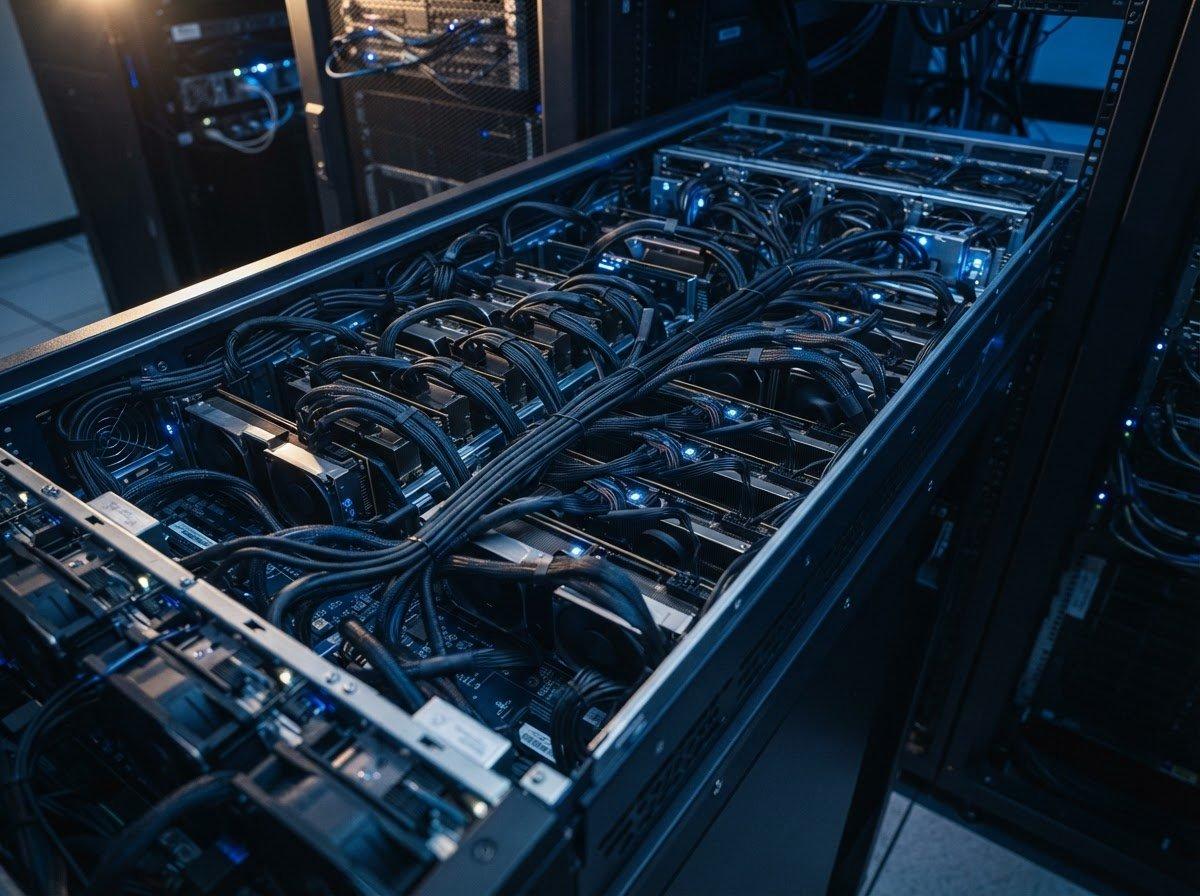
NVLink and InfiniBand solve different communication problems in an AI cluster, so they work together rather than compete. NVLink moves data within a tightly coupled GPU system, while InfiniBand carries traffic between servers; treating either as a universal replacement creates an incomplete design.
Introduction
For large-scale training, the practical architecture is usually NVLink inside the compute domain and InfiniBand across the cluster. NVLink provides the local GPU communication path, while InfiniBand provides remote direct memory access between nodes without involving the software data-movement path. This boundary matters more than a headline bandwidth comparison because a single network number hides the bottleneck that actually limits a training step. A cluster can have powerful GPUs and still stall when its topology mismatches its communication pattern.
Key Takeaways
NVLink connects GPUs within a tightly coupled scale-up domain.
InfiniBand connects servers across the scale-out cluster fabric.
Measure communication bytes and effective bandwidth before buying more GPUs.
NVLink Defines the Local GPU Communication Domain
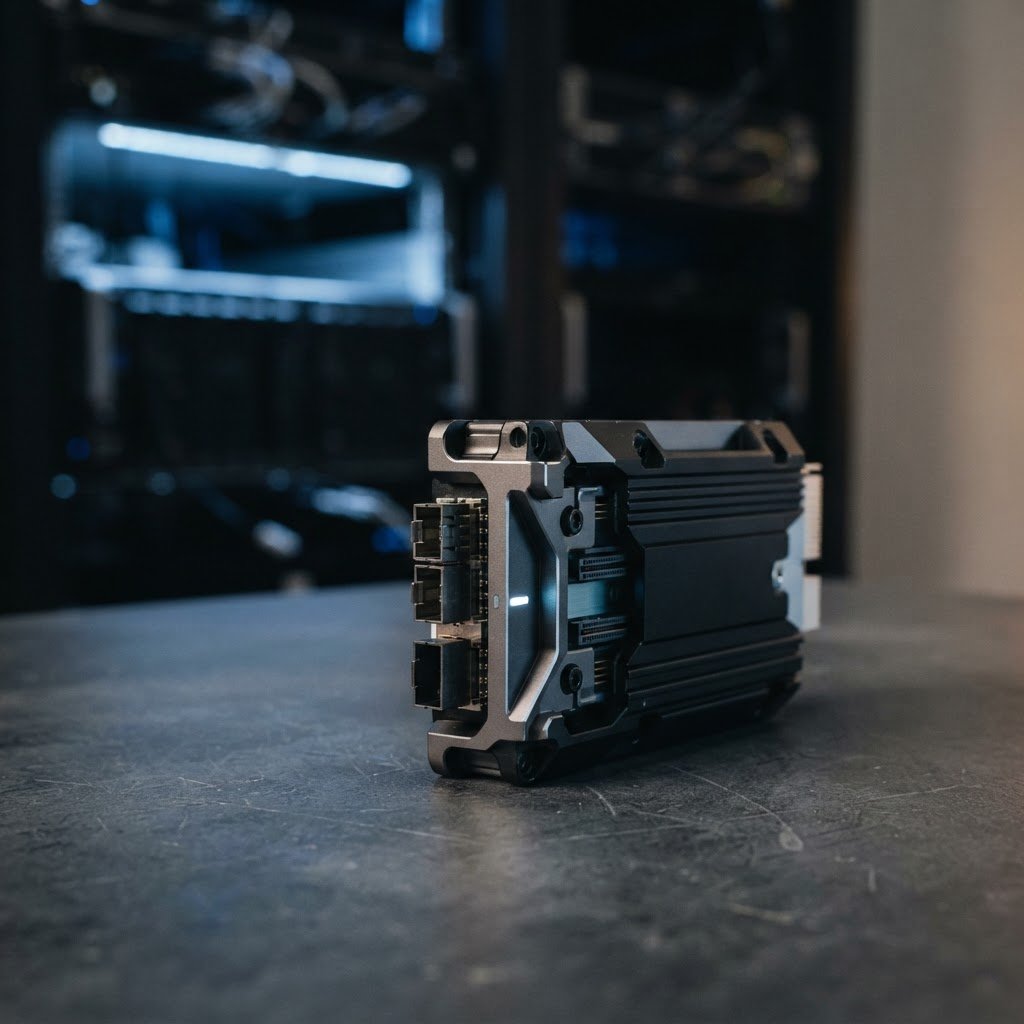
Production AI infrastructure starts by separating local GPU exchange from cluster-wide networking. NVIDIA NVLink technology is a scale-up interconnect that links GPUs in a server or platform-managed domain, allowing workloads to exchange tensors, activations, and model-state data without routing traffic through the CPU. That local path is central to GPU interconnect bandwidth when model parallelism keeps multiple accelerators on one coordinated job.
What NVLink Does Inside a Node
NVLink is built for frequent, latency-sensitive GPU-to-GPU communication. In a single eight-GPU server with NVLink, communication accounts for 5% to 10% of runtime in one cited training analysis, which shows why local topology still matters even before training extends to multiple servers.[1]
Tensor exchange: Moves activations and gradients between cooperating GPUs.
Memory access: Supports GPU-to-GPU data movement without CPU routing.
Scale-up domain: Keeps tightly coupled accelerators on a local fabric.
Fabric scope: Extends high-bandwidth GPU communication within a supported local platform.
Why PCIe Is a Different Baseline
NVLink vs PCIe bandwidth is not only a throughput comparison. PCIe GPU-to-GPU transfers can traverse the CPU path, while NVLink creates a direct accelerator communication path; that difference changes synchronization overhead in distributed deep learning. The relevant decision is not whether PCIe exists in the server, but whether the model’s local communication pattern needs a dedicated GPU fabric.

InfiniBand Extends Training Across Servers
InfiniBand is the scale-out layer in an NVIDIA GPU cluster interconnect design. It connects nodes so GPUs in separate servers can exchange data through messaging and RDMA operations, allowing the cluster to operate as a distributed system rather than an isolated collection of GPU boxes. AI cluster interconnects need both layers when a workload outgrows one tightly coupled domain.[2]
Where the Boundary Falls in Real Topologies
Within a server, NVLink coordinates the GPUs assigned to that node. Between servers, InfiniBand transports collective communication, parameter synchronization, and remote data exchange across the fabric. This is why scaling AI training with NVIDIA interconnects requires two capacity plans: local GPU connectivity and cluster network capacity.
The table separates the technologies by their operational role rather than pretending they are interchangeable products.
Decision area | NVLink | InfiniBand |
|---|---|---|
Primary scope | GPU scale-up domain | Server-to-server scale-out fabric |
Communication path | Direct GPU exchange | Messaging and RDMA across nodes |
Topology question | How GPUs cooperate locally | How nodes cooperate cluster-wide |
Capacity planning input | Local tensor traffic | Cross-node bytes per training step |
The important tradeoff is architectural: NVLink cannot eliminate the need for a cluster fabric, and InfiniBand cannot turn loosely connected GPUs into one local scale-up domain.
How to Find the Actual Bottleneck
Model the communication phase from workload bytes rather than advertised FLOPS: divide bytes transferred per step by measured effective bandwidth, then compare the result with compute time and overlap opportunities. interconnect bottleneck research reinforces the operational point that distributed training requires continuous communication, not occasional network use.[1] This calculation should be considered alongside LLM infrastructure costs, because idle accelerators turn a topology mistake into an operating-cost problem.
Choose the Interconnect Layer That Matches the Workload
Start with the model’s parallelism strategy, then map its communication to the correct layer. Tensor-heavy work that keeps shards on GPUs within a node stresses NVLink; jobs that spread replicas, pipeline stages, or collective operations across servers stress InfiniBand. effective bandwidth planning is more useful than peak specifications because it accounts for real workload bytes and overlap.[3]
Procurement Questions That Prevent Bad Designs
Ask how many GPUs must communicate as one local domain, how often the job crosses node boundaries, and whether the communication phase overlaps compute. Also examine failure operations: Large deployments should also assess operational maintainability alongside communication requirements. These are AI infrastructure decisions, not isolated server specifications.
Apply the Same Logic to Inference
Training is not the only case that benefits from topology discipline. A distributed inference architecture may also require fast local exchange for model shards and a separate fabric for routing work across machines. In production, utilization, failure handling, and workload communication matter more than a component-level comparison.
Conclusion
NVLink and InfiniBand are complementary layers: one scales GPU communication locally, and the other scales the cluster across nodes. Size NVLink around tightly coupled GPU traffic, then size InfiniBand around measured cross-node bytes per step. Do not use peak FLOPS as a proxy for fabric needs. For teams evaluating practical architecture choices, NinjaStudio.ai is a useful resource for connecting research claims to deployment constraints.
Need a clearer framework for evaluating cluster topology? Explore NinjaStudio.ai's analysis for production-focused AI infrastructure guidance.
Frequently Asked Questions (FAQs)
What is NVLink and how does it work?
NVLink is a GPU interconnect that enables direct communication among GPUs in a tightly coupled system, reducing reliance on CPU-routed transfers when workloads exchange tensors, activations, or model-state data frequently.
Why is NVLink faster than PCIe for AI workloads?
NVLink is faster for many AI communication paths because it supports direct GPU-to-GPU exchange, whereas PCIe transfers may traverse the CPU path and add avoidable overhead during repeated synchronization.
Is NVLink necessary for large language model training?
NVLink is necessary when a large language model uses tightly coupled GPUs that must exchange substantial local data, but cluster-scale training also needs a separate network fabric for communication between servers.
How do NVLink switches impact cluster scalability?
NVLink switches impact local scalability by extending the scale-up fabric across a managed GPU domain, while rack and cluster growth still depends on the separate inter-node network design.
Is NVLink compatible with all NVIDIA data center GPUs?
NVLink compatibility depends on the specific NVIDIA GPU platform and system design, so buyers should verify the supported local topology rather than assuming every data center GPU exposes NVLink connections.
Sources
- Part 7: The Interconnect Bottleneck — lewislin.substack.com ↩
- NVLink, InfiniBand, and UALink: A Full Guide to How AI GPUs Actually Talk — Inside Deep Tech ↩
- AI Cluster Networking: NVLink, Infinity Fabric, InfiniBand, and RoCE — Dr. TMA Pai Endowment Chair - ITIS ↩